Global equities staged a powerful rebound in Q2 2026, with the MSCI World Index up about 13.8% and emerging markets soaring 24%, driven largely by semiconductor and AI-related stocks. The S&P 500 gained 15%, its strongest quarter since 2020, while small- and mid-cap stocks outperformed, signalling a broadening rally.
Global Equity Market Performance (Q2 2026)
Overall Market Trends
- MSCI World Index: +13.8% (USD terms)
- Developed Markets: +13.9%
- Emerging Markets: +24% (best quarter since 2009)
- S&P 500: +15%, near record highs
- Small Caps: +22%
- Mid Caps: +17%
- International Equities: +17%
Key Drivers
- Artificial Intelligence (AI) Capex Boom:
- US hyperscalers raised 2026 capex guidance to USD 700 billion.
- Semiconductor sector surged, with some indices up 47–88%, marking the strongest quarter in decades.
- Geopolitical Relief:
- Middle East conflict de-escalated; US–Iran ceasefire framework signed.
- Oil prices fell from USD 115 to ~USD 70, easing inflation pressures.
- Earnings Growth:
- Global equities’ 2026 earnings growth estimates revised up to 27.6%, led by IT sector.
Risks & Challenges
- Inflation & Fed Policy:
- US inflation hit 4.2% in May, prompting Fed to consider rate hikes.
- Geopolitical Fragility:
- While tensions eased, Middle East risks remain.
- AI Concentration Risk:
- Rally heavily dependent on semiconductor and AI infrastructure; sustainability depends on continued capex.
Portfolio Performance as of June 2026
Total Return in USD
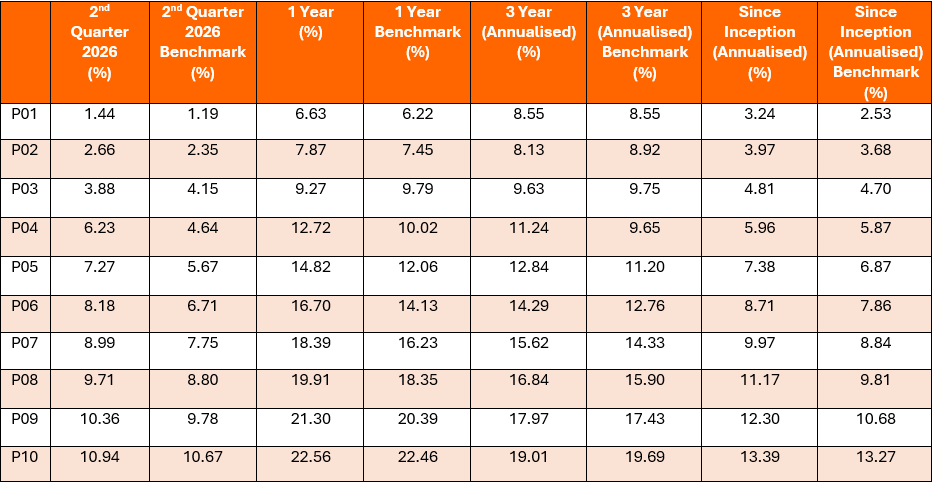
<Source: Morningstar Direct>
Total Return in MYR

<Source: Morningstar Direct>
Global equities are expected to remain supported in H2 2026 by resilient earnings and AI-driven capital spending, but investors should brace for volatility from energy prices, central bank policy, and stretched valuations. Analysts see continued upside in U.S. and Asia ex-Japan equities, with the S&P 500 potentially reaching 7,800–8,000 by year-end, though risks from inflation and geopolitical fragmentation persist.
Global Equity Market Outlook (2H2026)
Macro Backdrop
- Resilient Growth: Consumer spending and labor markets remain strong, supporting global expansion.
- AI Supercycle: Heavy investment in AI infrastructure continues to drive earnings growth and capital spending.
- Energy Prices: Oil expected to stabilize around USD 78/bbl Brent by year-end, easing inflation pressures.
- Central Banks: Fed likely to stay on hold through 2026; DM central banks may hike unevenly due to sticky inflation.
Risks & Challenges
- AI Valuation Concerns: Profit-taking in semiconductor stocks shows investor caution; sustainability of AI capex is questioned.
- Geopolitical Fragmentation: Middle East tensions, supply chain regionalization, and defense spending shifts add uncertainty.
- Inflation & Policy: Sticky inflation may limit rate cuts; Fed’s stance remains a key anchor for risk assets.
- Equity Supply: Strong IPO pipeline could create short-term oversupply risks.
Key Takeaways for Investors
- Equities remain overweight in most outlooks, especially U.S. and Asia ex-Japan.
- Diversification is critical: AI-linked sectors dominate, but opportunities extend to industrials, financials, and utilities.
- Gold remains a strategic diversifier, with targets around USD 5,100 by mid-2027.
- Malaysia context: As part of EM, Bursa Malaysia could benefit from softer energy prices and semiconductor-linked demand, though volatility in global capital flows remains a risk.
Sources: Morningstar, IMF, Schroders, JP Morgan
Disclaimer:
Past data and performance do not indicate future performance. Actual individual investor performance will vary depending on the initial investment, amount and frequency of contributions, allocation changes, taxes and fees during the time frame considered.